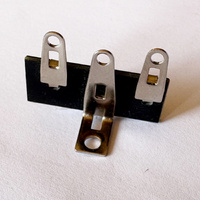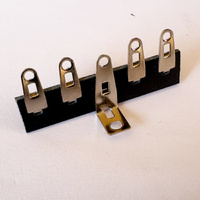


Vulcanized Fiber Board for building your own eyelet boards
Ideal for amp eyelet boards
SKU code: Fiberboard
Vulcanized Fiber Boards
These Vulcanized Fiberboard need to be sealed.
- 76mm wide
- 380mm long
- 1.5mm thick
Note: These are raw fiber boards. You need to seal these boards before using them. Evatco does not endorse the use of these types of boards. Fibreglass boards are significantly better for building guitar amplifiers and we only offer these for techs trying to keep vintage appearance.
Note: Vulcanized fiber eyelet boards (commonly used in vintage Fender-style amplifiers) are hygroscopic—they absorb ambient moisture over time. Combined with old solder flux, dirt, and decaying factory paraffin wax, this causes high DC voltages to leak across the board, leading to popping, crackling, and "ticking" noise.
Sealing the boards prevents moisture re-entry. Note: Steps 1& 2 are for a board that is from an existing vintage amp. Point 3 onwards are only relevant for a new board. The method below is but one way. If you are not sure, we recommend looking around for other sources of information.
1.Prep and Strip the Board:Ensure no active electronic components are attached.
Remove all components, wires, and eyelets (or work with a bare, newly drilled replica board). If restoring an original board, strip off all components first. Trying to seal a fully populated board traps moisture underneath components and near eyelets.
2.Clean Away Wax, Dirt, and Solder Flux:Solvent bath required for vintage boards.
Scrub the fiber board thoroughly using 99% Isopropyl Alcohol (IPA) or acetone with a stiff nylon brush. If the board was originally wax-dipped by Fender, use a heat gun on low heat held over paper towels to melt and draw out as much old paraffin out of the fibers as possible before the alcohol wash.
3.Bake Out Trapped Moisture:Crucial step to remove internal water content.
Place the cleaned fiber board on a clean baking sheet inside a low-temperature oven set to 70°C–80°C (160°F–175°F) for 3 to 4 hours. This slowly bakes out deeply embedded atmospheric moisture without warping or charring the material.
4.Apply the First Sealing Layer:Work while the board is still warm.
Remove the board from the oven while warm and immediately coat all sides and edges with your choice of sealant:
Shellac (Flakes dissolved in denatured alcohol): The traditional choice; penetrates deep into warm cellulose fibers and dries rock-hard.
Acrylic Conformal Coating (e.g., MG Chemicals 419D): Modern, high-dielectric industrial standard for circuit protection.
Clear Nitrocellulose Lacquer: Common among amp builders; thin coats work well.
5.Lightly Sand and Re-Coat:Build a moisture-proof barrier.
Allow the first coat to dry completely (about 1–2 hours). Lightly scuff the surfaces with 400-grit sandpaper or Scotch-Brite to knock down raised fibers. Wipe away dust with a dry tack cloth and apply a second thin coat of sealant. Be sure to coat the inner edges of the eyelet/turret mounting holes.
6.Stake Eyelets and Assemble Circuit:Final hardware installation.
Once fully cured (24 hours), press and stake your brass/tin eyelets into the top board. If using a backing insulator board (the plain fiber board mounted beneath the eyelet board), ensure it undergoes the exact same baking and sealing process before mounting.
| SKU | Fiberboard |
| Brand | Generic |
| Shipping Weight | 0.5000kg |
| Shipping Width | 0.070m |
| Shipping Height | 0.015m |
| Shipping Length | 0.390m |
| Shipping Cubic | 0.000410000m3 |
Be The First To Review This Product!
Help other Evatco users shop smarter by writing reviews for products you have purchased.