
Potentiometer Taper Charts
Author: kevinm Date Posted:14 August 2017
Potentiometer Taper Charts
A taper describes how a potentiometer's resistance changes as you turn the knob. Pick the wrong one and a volume control can feel sudden or a tone control can feel dead. These charts show what each taper does.
How to read the charts
- Horizontal axis: how far the shaft has turned, from fully anticlockwise (0%) to fully clockwise (100%).
- Vertical axis: the resistance measured at that point, where R is the pot's rated value (a 500k pot has R = 500kΩ).
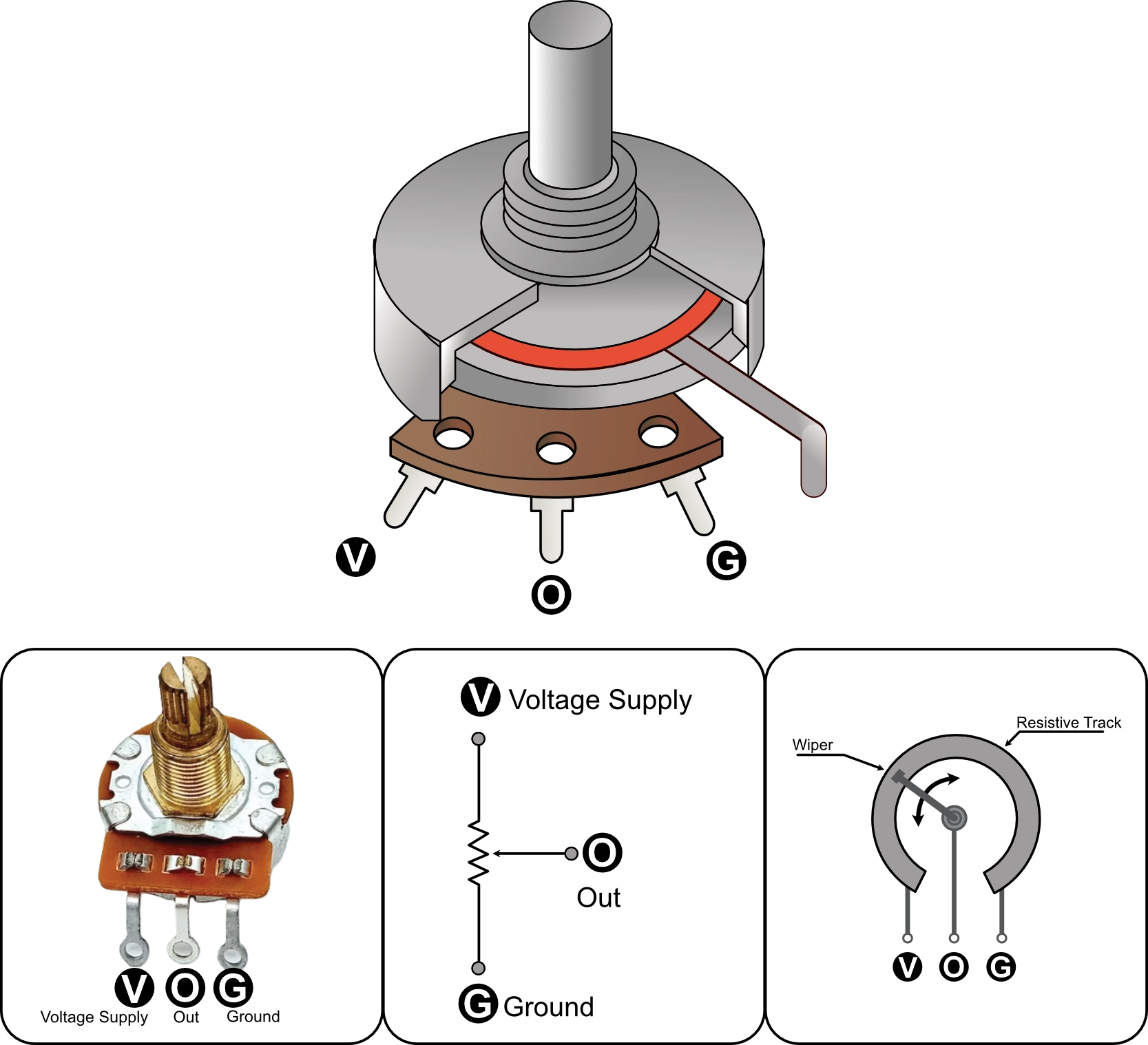
- Lugs: unless noted, resistance is measured between the wiper (centre lug) and cold lug. The wiper is always the centre lug. Hot and cold are the outer lugs, and which side each sits on depends on the pot and the way you are viewing it.
| Taper | Code | Feel | Common use |
|---|---|---|---|
| Linear | B | Even all the way round | Trim, bias, general control |
| Audio | A | Gentle start, steep finish | Volume controls |
| Reverse audio | C | Fast start, gentle finish | Special tone and bleed circuits |
| No-load audio | Varies | Audio curve, open at full | Tone controls |
| M and N | M / N | Two sections, centre detent | Blend and balance |
Linear taper (B)
Resistance changes in direct proportion to knob rotation. Halfway round, you have half the total resistance. This is the taper to choose when you want an even, predictable change across the whole sweep.
Measured between the wiper and cold lugs. R is the pot's rated value.
Typical uses: gain and bias trim controls, tone controls in some designs, and any variable resistor where equal steps should give equal changes.
Audio taper (A, logarithmic)
Resistance starts slowly and climbs steeply towards the end of the sweep. At 50% rotation the wiper sits at only about 10–20% of R, depending on the manufacturer. Our ears hear volume logarithmically, so this curve makes a volume control feel smooth and even.
Measured between the wiper and cold lugs, with the pot wired as a voltage divider.
Typical uses: volume controls on guitars and amps, and most master and channel volume controls.
Reverse audio taper (C)
The mirror image of an audio taper. Resistance rises quickly at first, then levels off towards the end of the sweep. Rotation feels fast at the start and slow at the finish.
Measured between the wiper and cold lugs. Wired the other way round, a standard audio pot behaves like this.
Typical uses: some tone and treble-bleed circuits, and designs where a control needs fine adjustment near full. Always confirm in the circuit's documentation before swapping.
Audio taper, no load
A no-load pot has the resistive track stopped short of the hot end. Resistance follows an audio curve, then the wiper leaves the track at full rotation and the circuit goes open (infinite resistance). Used as a tone control, this takes the tone circuit out of the signal path at 10.
Measured between the wiper and cold lugs. At 100% rotation the connection is open.
Typical uses: Fender-style and other guitar tone controls where full-open should leave the signal completely untouched.
M and N taper (blend and balance)
M and N tapers come in dual-gang pots with a centre detent. Each section has its own curve. In one half of the rotation, one section does all the work while the other stays fixed. That lets one knob blend two signals or balance two channels, with a click at the centre where both sit at full value.
M is the top section and N is the bottom section. In the first chart, both are measured between wiper and cold.
Turning from 0% to 50%, M rises from 0 to R while N stays at 0. From 50% to 100%, M stays at R while N rises.
Measuring N from the hot lug
Measure N between the wiper and hot lug instead and its curve flips: N holds at R until the centre, then drops to 0 at full rotation. M is unchanged. Both versions describe the same pot, so check which lug the datasheet measures from.
Typical uses: balance controls, dual-channel blends and mixers, and pan controls.
Taper letter codes are not standardised. They differ between manufacturers and regions, and the same letter can mean different curves on different brands. Check the datasheet for the curve you need, especially when replacing a vintage pot.


